TL;DR: Arct Cloud servers ping the matching Jito mainnet block engine at:
- Salt Lake City: 0.046 ms avg
- Tokyo: 0.056 ms avg
- Amsterdam: 0.058 ms avg
- Frankfurt: 0.891 ms avg
All numbers are 10-packet ICMP averages with 0% loss. Three of the four regions are colocated with Jito; Frankfurt is a short multi-hop in-region path. The rest of this post shows the raw ping data, explains why those microseconds decide which bundles land, and covers what your server has to do well beyond the network.
On Solana, the difference between a profitable bundle and a missed one is often measured in microseconds, not seconds. When a leader rotates in Tokyo and your transaction has to traverse the public internet from a generic cloud region, you have already lost the race, no matter how clever your strategy is.
Arct Cloud places its servers in the same data centers as Jito's regional block engines, so your transactions reach the auction with sub-millisecond network latency. This guide walks through the measured ping numbers from every Arct region to its matching Jito endpoint, explains why that latency profile matters for bundle landing, and covers what else, beyond network, your server has to do well to win on Solana.
Why Latency to Jito Block Engines Decides Bundle Outcomes
Jito's block engine accepts bundles and transactions from searchers and traders, runs an off-chain auction, then forwards winning bundles to the current Solana leader. Two facts make latency a first-class variable:
- Bundle auctions are time-bounded. The block engine has a narrow window to assemble a bundle before forwarding it to the leader. Submissions that arrive late are not retried into the next slot, they are simply discarded.
- Solana leader slots are 400 ms. With block times that short, every additional 50–100 ms round trip is a meaningful fraction of the slot. By the time a 150 ms transcontinental hop completes, the leader you were targeting may already be done.
Jito's own documentation recommends connecting to the geographically closest endpoint and explicitly warns that during high-demand periods the network is congested and minimum tips may not be enough. In other words: when the auction is competitive, latency is the difference between landing and not landing, tips alone don't save you.
This is why Jito operates nine mainnet regional endpoints: Amsterdam, Dublin, Frankfurt, London, New York, Salt Lake City, Singapore, Tokyo, and a global default. And it is why Arct Cloud's regions are placed against that exact list.
Measured Latency: Arct Cloud to Jito Block Engines
The numbers below are 10-packet ICMP pings from production Arct Cloud servers to the matching Jito mainnet block engine hostname. We are showing raw terminal output rather than a pretty chart so you can verify exactly what we are claiming.
Tokyo → tokyo.mainnet.block-engine.jito.wtf
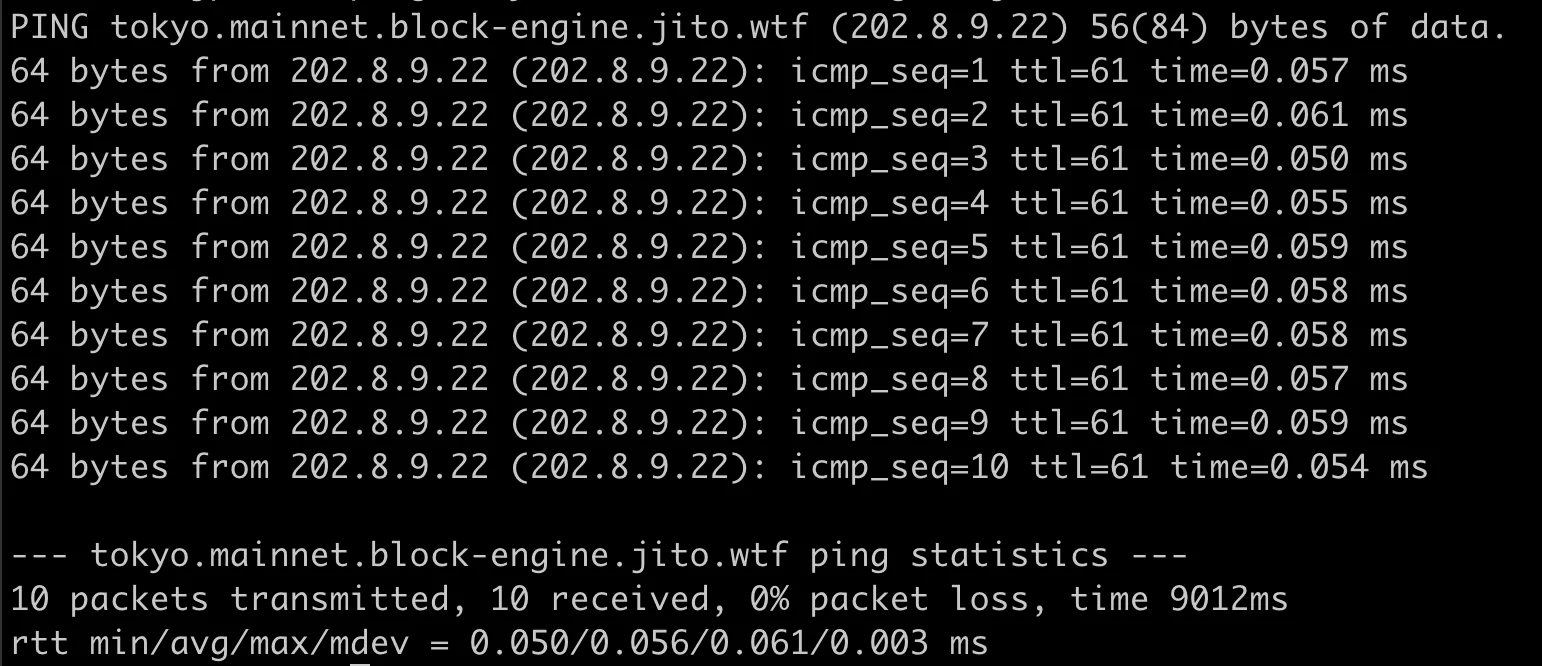
- Average RTT: 0.056 ms (56 microseconds)
- Min/max: 0.050 / 0.061 ms
- TTL 61, 0% packet loss
At 56 microseconds, this is colocation, the request and response don't leave the building. For comparison, a typical transcontinental hop is 60–80 ms, more than three orders of magnitude slower.
Salt Lake City → slc.mainnet.block-engine.jito.wtf
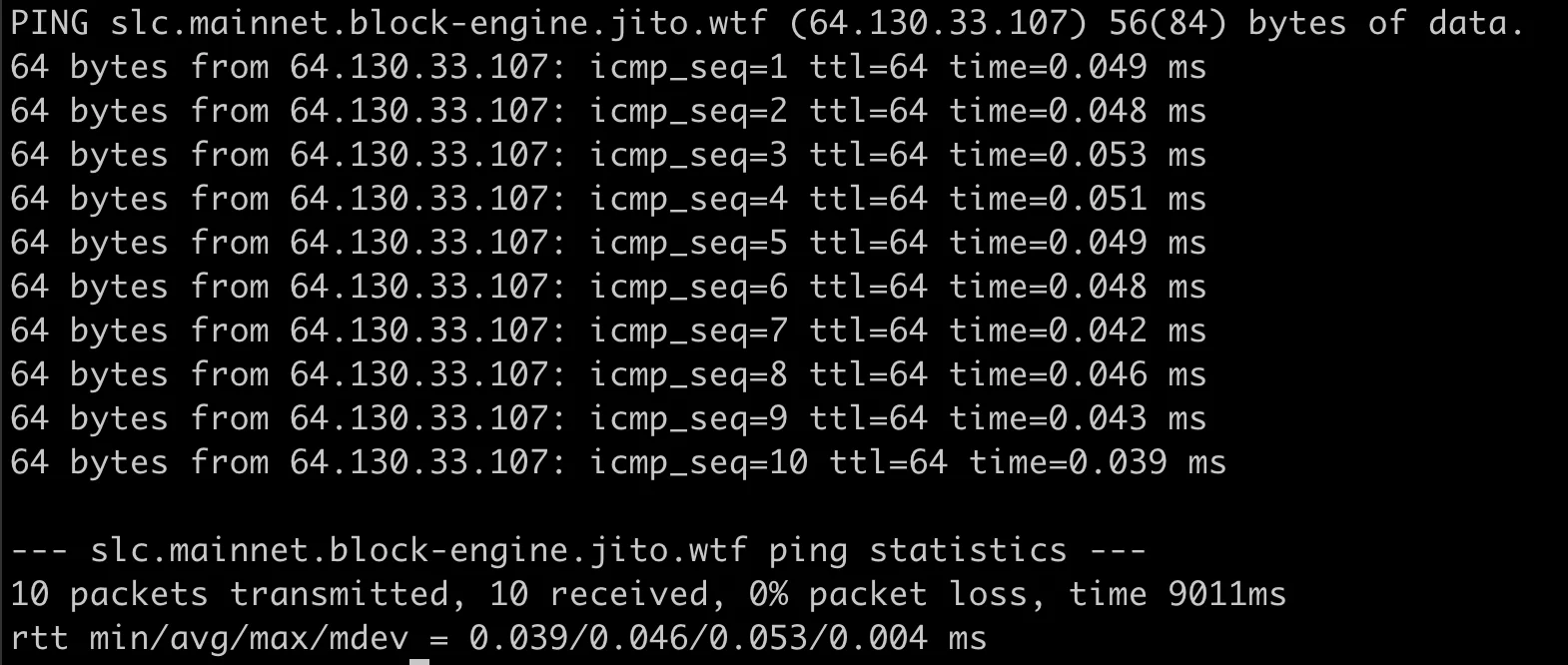
- Average RTT: 0.046 ms (46 microseconds)
- Min/max: 0.039 / 0.053 ms
- TTL 64, 0% packet loss
TTL 64 here indicates the same Layer 2 segment, effectively a single switch hop. SLC is the closest North American endpoint for searchers who want to be near US-based validators.
Amsterdam → amsterdam.mainnet.block-engine.jito.wtf
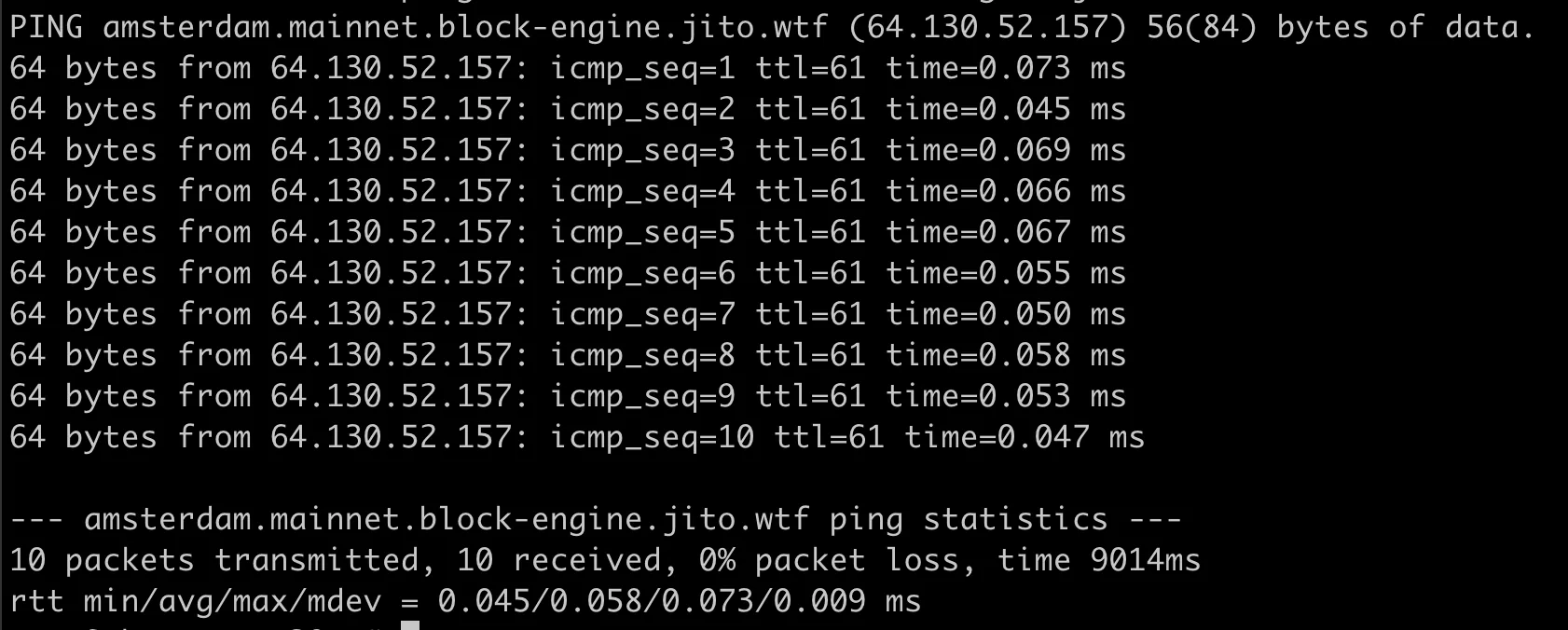
- Average RTT: 0.058 ms (58 microseconds)
- Min/max: 0.045 / 0.073 ms
- TTL 61, 0% packet loss
Amsterdam is the primary European Jito endpoint and consistently the highest-throughput EU region during peak hours. Sub-100µs RTT means your bundle reaches the auction faster than the kernel typically schedules a context switch.
Frankfurt → frankfurt.mainnet.block-engine.jito.wtf
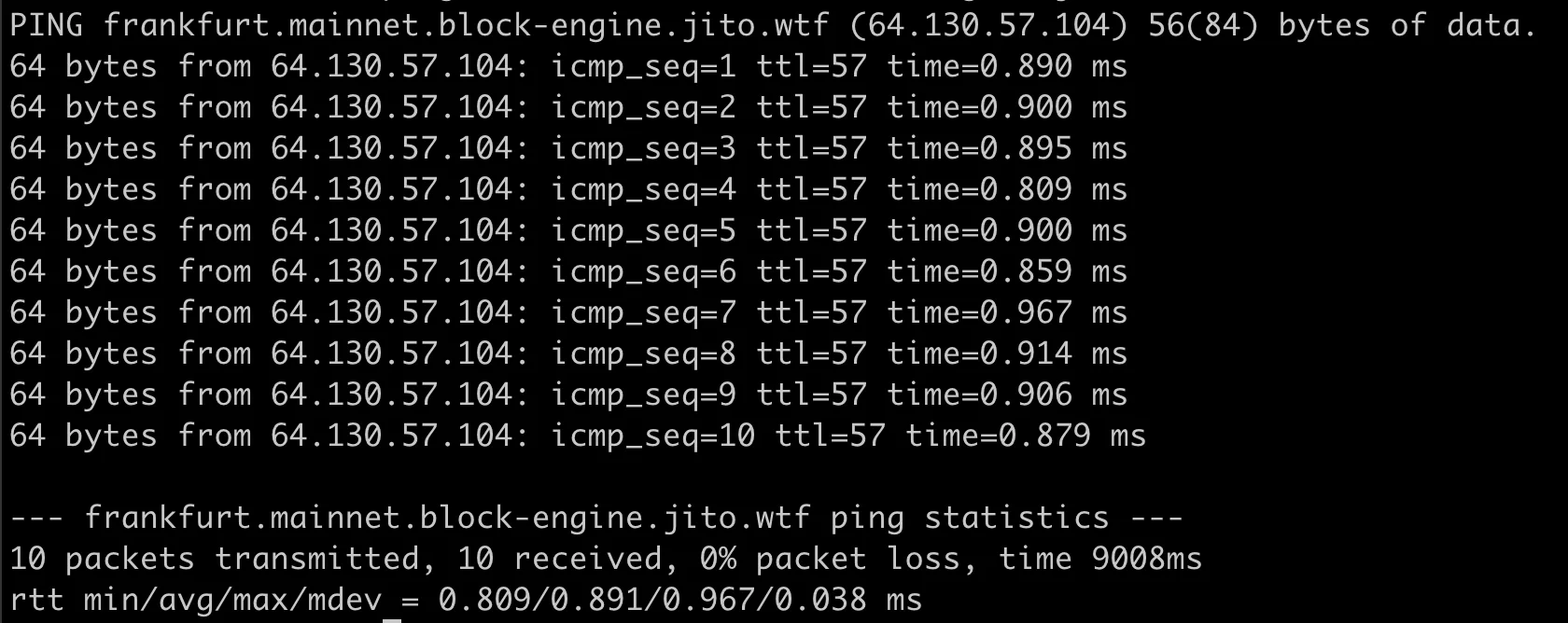
- Average RTT: 0.891 ms
- Min/max: 0.809 / 0.967 ms
- TTL 57, 0% packet loss
Frankfurt sits at a different point on the curve: still well under 1 ms, but a few network hops rather than colocation. The trade-off is geography, Frankfurt is the right anchor for German, Swiss, and Eastern European traffic where the in-region Jito endpoint is the better target than routing to Amsterdam.
At a Glance: Regions, Endpoints, and What They Are For
- Tokyo:
tokyo.mainnet.block-engine.jito.wtf, 0.056 ms avg. APAC searchers, Asian leader windows. - Salt Lake City:
slc.mainnet.block-engine.jito.wtf, 0.046 ms avg. North American MEV; close to US validator concentration. - Amsterdam:
amsterdam.mainnet.block-engine.jito.wtf, 0.058 ms avg. Primary EU endpoint, highest throughput in Europe. - Frankfurt:
frankfurt.mainnet.block-engine.jito.wtf, 0.891 ms avg. DACH region anchor; sub-ms even with multi-hop routing.
The pattern is intentional: in three of four regions the server is in the same rack or row as the Jito block engine, and in the fourth it is still inside the sub-millisecond envelope. That floor matters because you cannot optimize away network latency in software: once you've paid it, it's gone.
Latency Is Necessary, But Not Sufficient: Why CPU Performance Matters
A colocated server with weak CPU is a fast pipe to a slow pipeline. By the time the request leaves your application, the auction may already be closing. Solana MEV workloads stress the CPU in three specific ways:
1. Transaction Signing and Serialization
Every bundle you submit needs to be signed locally. Ed25519 signing is fast in isolation, but trading bots routinely sign and serialize hundreds of candidate transactions per second as opportunities flicker in and out of profitability. On a slow VPS with shared, oversubscribed cores, signing throughput stalls, and the bundle you wanted to submit at slot N actually goes out at slot N+2.
2. RPC Response Parsing and Strategy Evaluation
Trading bots subscribe to one or more Solana RPC streams, accountSubscribe, programSubscribe, logsSubscribe, or Geyser/Yellowstone, and parse a constant firehose of account updates. Parsing JSON or Protobuf, decoding instruction data, simulating downstream effects, and deciding whether to act all happen on the hot path. Every CPU stall here pushes your decision to the next slot, where the opportunity is gone.
3. Tip Calculation and Bundle Construction Under Load
Jito's tip floor moves dynamically, the 25th, 50th, 75th, 95th, and 99th percentile tip values are published continuously and can shift by an order of magnitude in seconds during volatile windows. Bots that adjust tips reactively need to compute the right tip and reconstruct the bundle in microseconds. On busy cores, this loop blows past the slot budget.
In short: high-clock CPU cores are the multiplier that turns low network latency into actually-landed bundles. Current Arct Cloud choices include AMD EPYC Milan 7003 Series on Cost Optimized and General Purpose, and DDR5 RAM with AMD Ryzen 9 or AMD EPYC Genoa 9004 Series on High Performance, plus NVMe storage.
How to Pick the Right Region for Your Workload
Choose by where your strategy needs to be fastest, not by where you live:
- Searcher running APAC-leader-aware bots? Tokyo. Your edge is being inside the building when an Asian validator becomes leader.
- US-focused arbitrage or sandwich detection? Salt Lake City. SLC sits on the same network segment as Jito's SLC endpoint and has good onward latency to major US validator clusters.
- EU-wide trading desk with cross-protocol exposure? Amsterdam. Highest peak throughput, primary EU Jito endpoint.
- Regional setup serving DACH or Eastern Europe? Frankfurt. Even at ~0.9 ms it is still inside Jito's recommended envelope and beats any non-EU origin by 20–80×.
Many serious operators run multi-region: a server in each Jito region, with the bot routing each candidate bundle to the closest endpoint based on which validator is the upcoming leader. Arct Cloud charges per region, and the regions share a consistent OS image and provisioning interface, so a four-region MEV fleet is the same workflow as a single box, just repeated.
Sanity-Check Your Setup
Before going to production, three quick checks save a lot of debugging:
- Ping the endpoint you plan to use.
ping tokyo.mainnet.block-engine.jito.wtf(or your region) should return RTT well under 5 ms. If you see 50 ms+, your server is in the wrong place, change it before tuning anything else. - Measure end-to-end
sendBundleround trip from your code. Network ping is the floor, not the actual cost. Add up TLS handshake (use a persistent connection), serialization, and RPC processing. - Run a sustained signing benchmark on your CPU. If your bot signs 200 txs/sec on a benchmark but your VPS sustains only 40/sec under load, the bottleneck is shared CPU, not Jito.
The Bottom Line
Latency to the Jito block engine is the floor below which no amount of code optimization can take you. Arct Cloud's Tokyo, SLC, Amsterdam, and Frankfurt regions put that floor at 50–900 microseconds, measured, not marketed. Paired with ample CPU headroom and clean network paths, that's the infrastructure baseline serious Solana MEV needs.
If you are building a Jito-using bot or trading system, explore Arct Cloud's Solana-region pricing and pick the region nearest the auction. Beyond Jito, the same Amsterdam servers sit sub-millisecond from the wider Solana trading VPS stack, Helius, NextBlock, Temporal, and more. You can always add more regions later, but you cannot retroactively buy back the milliseconds you spent routing through the wrong continent.